← first chords, first songs, at any age
Easy Piano Songs for Beginners (A List That's Actually Beginner)
Start with Twinkle Twinkle, Heart and Soul, and Jingle Bells, and for pop songs use an easy-piano book keyed to your method book instead of falling-note videos.
 Gus Harmon · Updated July 8, 2026 · how I decide
If you buy through my links the site earns a little. It's never why I pick things.
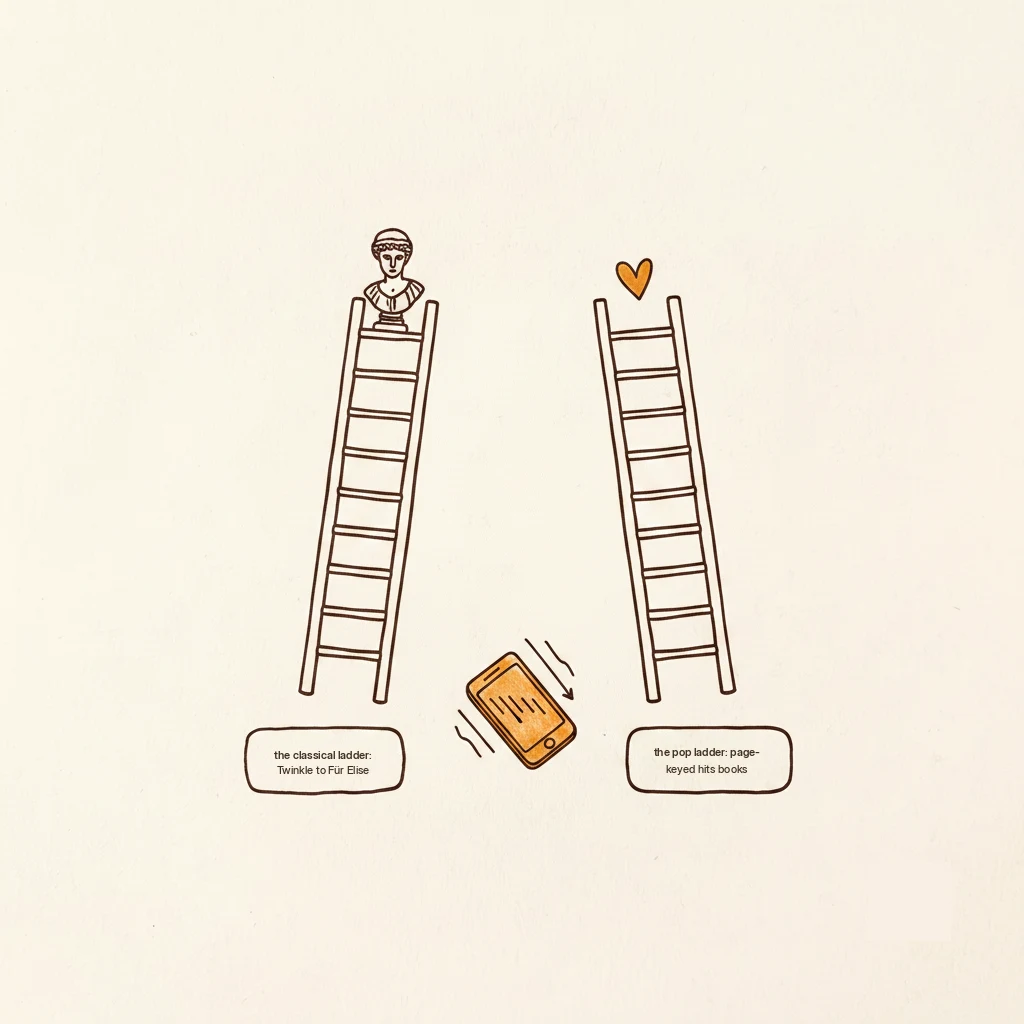
The honest first piano songs are the ones every player actually started with: Twinkle Twinkle, Jingle Bells, and Heart and Soul, then a classical ladder up to Für Elise. For pop songs, use an easy-piano book keyed to your method book. Falling-note YouTube videos teach you to copy lights, not read music.
Here’s the actual problem, and a beginner named it perfectly in a thread I read: “I’ve gone down the YouTube easy and beginner piano song tutorials, but there are thousands and none of them seem beginner to me.”
That’s not you being lazy or slow. That’s a curation problem. “Easy” on YouTube usually means “easy for someone who already plays.” Nobody’s sorting these songs by what a genuine beginner’s hands can actually do yet. So let me sort them.
The true first songs (no shame in them)
These are the ones real players started on. Not baby songs. Starting songs.
- Twinkle Twinkle Little Star and Mary Had a Little Lamb. Simple melodies you already know, which means your ear catches your mistakes.
- Jingle Bells. Same deal, and a crowd-pleaser in December.
- Heart and Soul. The duet everybody learns, the one you play with a friend or a grandma on the other half of the keys.
Play these. They build the habit of your fingers going where your eyes tell them.
The classical ladder
If you want the “real piano” feeling, this is the order players climb it in.
- Minuet in G. The first piece that sounds properly like piano playing.
- Prelude in C (Bach). One player put it well: it “helped me get arpeggios down before I even knew what arpeggios were.” An arpeggio is just the notes of a chord played one at a time instead of together.
- Für Elise. Here’s the honest part: most people only ever learn the famous opening, and that is completely fine. The full three-part version is more of a year-two goal than a week-one one. Learn the opening, enjoy it, come back for the rest when you’re ready.
And keep your expectations kind. A player said their real goal song, Clair de Lune, “took me three years, worth every second.” The beautiful stuff is real, and it’s often far off. Both of those are true. Knowing that up front is how you keep going instead of quitting when it doesn’t come in a month.
For pop songs, buy a book, not a video
The single best move for learning pop songs on piano is an easy-piano book that’s keyed to your method book, not another YouTube tutorial. A book meets you at your level and moves in real steps. A falling-note video meets you nowhere and teaches a habit that quietly wrecks your reading.
Alfred’s Adult All-in-One (Book 1) plus its page-keyed Greatest Hits series. Roughly $16 for the method book and about $12 for the hits book. The pairing is the magic: once you can handle page 30 of the all-in-one, the hits book tells you which songs you’re now ready for. It’s the only genuinely sequenced pop path I know of.
Flaws, said plainly: it asks you to work through a method book, which is slower than jumping straight at your favorite song. That slower path is exactly why it works.
If you want a different method with the same idea, Faber’s Adult Piano Adventures is a solid alternate (about $18). For the specific-song itch, an easy-piano Disney or pop songbook (around $15 to $18) scratches it. For the modern, cinematic, Einaudi-style sound, that’s its own shelf worth exploring later.
The one hard no
Falling-note YouTube tutorials, the ones with colored bars raining down onto the keys. A pianist put it bluntly: “DO NOT USE THEM. They hurt you if you ever start to read and play music.” They train you to copy lights instead of read the page, and unlearning that later is miserable. When a tutorial shows falling lights, close it.
Songs written in numbers or letters instead of notes
Maybe you’ve seen sheets where the notes are replaced with numbers or letters, and honestly, that’s the version that looks possible when a real music staff looks like math. Two different things get sold under that name, so let’s untangle them.
Numbers on their own usually mean fingers. Piano teaching numbers your fingers 1 through 5, thumb first, on both hands, and beginner books print those little numbers over the notes as training wheels. That kind of numbering is great, and your method book already uses it. Letters are the notes’ actual names, A through G, written out so you can find the key without reading the staff yet.
Here’s the thing. As a way to play your very first song this week, numbers and letters are fine. Day one should feel like music, not homework. But apps selling whole libraries of number-only songs are selling the falling-lights trap on paper: you end up copying symbols forever instead of reading, and the hundreds of real songbooks out there stay locked. Use numbers to get going, then let the method book quietly swap them out for the real thing. That’s what it’s built to do.
And if you’re on a 61-key keyboard instead of a piano, relax: every song on this page fits. Here’s my whole keyboard-for-a-beginner walkthrough if you’re still picking one.
Heart and Soul is secretly one of the best duet trainers ever, and here’s the trick hiding in it. The bottom part, the one the “easier” player takes, is just four chords repeating over and over: the same four-chord pattern that an enormous slice of pop music, doo-wop through today, still runs on. So a beginner grinding out the left hand of Heart and Soul is actually drilling the exact chord loop under hundreds of real songs, without knowing it yet. That’s why it feels so satisfying and so familiar at the same time. You’ve heard that four-chord engine your whole life. Heart and Soul just lets your hands finally sit down at it.
If you’re the adult on the bench
Plenty of the people hunting for beginner songs aren’t kids, and if that’s you, nothing above changes except your patience with yourself. The room I keep reading runs from a 33-year-old who was told she’s too old to a 62-year-old just getting started, and the working line in those threads is that “too late” comments say more about the person saying them. Twinkle Twinkle for a week, then straight up the same two ladders as everybody else. The Alfred’s book above literally has Adult on the cover; it starts grown, moves quicker, and skips the cartoon frogs. If you want the fuller version of that conversation, teachers and all, I wrote up the honest adult path here.
Buy the method book and its page-keyed hits book together. Put your phone on the music stand as a metronome and nothing else. When a YouTube tutorial starts raining colored lights down the screen, close it and go back to the page.
If you buy through my links the site earns a little coffee money. Doesn’t change the price, doesn’t change my answer.
Easy-piano picks follow the write-it-down process.
If you’re figuring this out, you’re probably also wondering:
Gus Harmon
Gus spent three decades running sound wherever somebody needed it: bar bands, weddings, school shows, and twelve years of Sunday mornings. He can't sing a note. He can make sure you're heard. Now he writes so normal people can buy the right thing the first time.