
← a microphone for singing, at home or on stage
Is the Shure SM7B Good for Singing? (Fix These Three Things First)
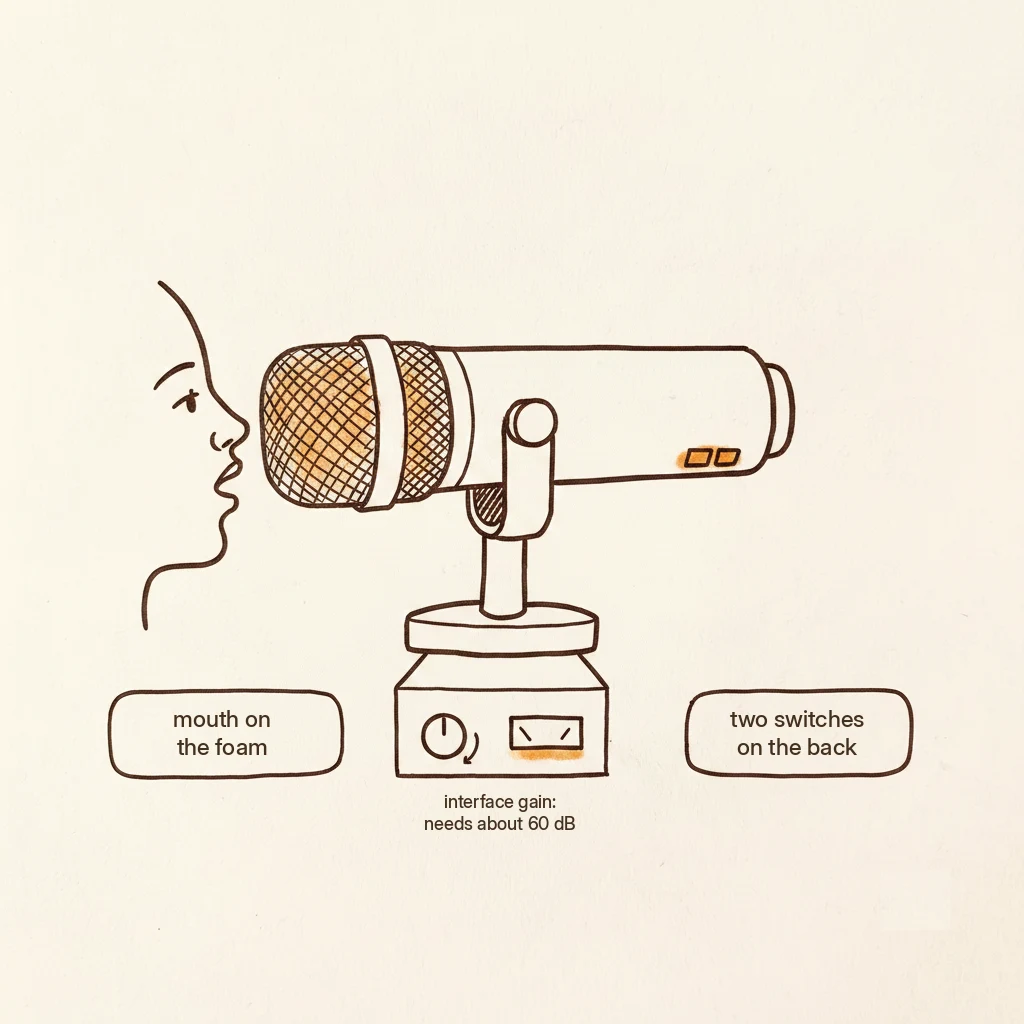
The SM7B is a proper singing mic, and if yours sounds quiet or dull the fix is almost always free: enough gain, your mouth closer, and two switches on the back.
 Gus Harmon · Updated August 22, 2026 · how I decide
If you buy through my links the site earns a little. It's never why I pick things.
Yes. Rock and rap lead vocals are what the SM7B was built for. If yours sounds quiet or dull, it’s almost never the mic: it needs about 60 dB of gain (most affordable interfaces run out), your mouth within a hand-span, and the two switches on the back set right for your voice. Fix those before you buy anything else.
You already own the SM7B. You bought it because every podcast and YouTube channel you watch uses one, or somebody got it for you as the serious upgrade. First recording: quiet, muddy, and hiss when you crank the knob all the way up.
You’re not alone. The top results for this mic are frustration threads where people say it ruins their voice or that they regret buying it. Those people weren’t doing anything unusual. They were missing three setup fixes.
The SM7B needs more from the box it plugs into (that box is called an interface, and it sits between the mic and your computer) than most home setups provide. That’s the whole mystery. Fix these three things and the mic wakes up.
Why yours sounds quiet
The SM7B has very low output. In plain terms, it whispers. It needs about 60 dB of gain (volume boost) from your interface, Shure says so themselves, and most affordable interfaces top out before that. So you crank the knob to max, and instead of a louder voice you hear hiss. That’s not the mic. That’s your interface straining.
Some people will tell you max gain with a little hiss is fine. If you can hear the hiss, it isn’t fine.
Here’s what to do about it, cheapest first:
Get closer (free). Moving from a foot away to a hand-span makes a bigger difference than you’d expect. More on this in the next section.
A Cloudlifter or FetHead. These are small boxes that sit between the mic and your interface and add the gain your box can’t provide on its own. A Cloudlifter CL-1 runs about $105 to $130 depending on the day. A FetHead is the cheaper alternative.
Shure also sells the SM7dB now, which is the SM7B with the booster built right in, for about $500.
A better interface. If yours is already old or underpowered, an interface with 60 dB or more of clean gain solves the problem at the source, and you skip the extra box.
The store’s answer to “my SM7B is quiet” is a $105 gadget. My answer: get closer and check the switches on the back first. Then we’ll talk about spending.
Get closer than you think
The SM7B is a dynamic mic (the tough kind that mostly hears what’s right in front of it). It was designed for a mouth a few inches away. That big foam windscreen exists so you can get that close without popping your p’s and b’s.
Back off to a foot and it goes thin and quiet. A hand-span or less is where the mic opens up. I’ve watched people stand two feet from a dynamic for decades, and it’s the single most common reason a good mic sounds bad. Get close. The foam is there for a reason.
The two switches on the back
Two small switches on the rear plate: a bass roll-off (cuts low-end rumble) and a presence boost (lifts the upper part of your voice that helps it cut through). Both start flat (off), and flat is the honest default.
If your voice sounds dull or muffled up close, flip the presence boost on. It lifts the clarity range without making you louder.
If you’re getting too much low-end rumble from singing close (that happens with all dynamic mics at short range, it’s called proximity effect), flip the roll-off on. It tames the bass without touching your midrange.
Two switches, two sentences each. That’s all there is to them. If you want to know how I sort a fix from a sale, the whole method is public.
Cloudlifter CL-1. A small inline booster (about $105 to $130) that sits between the SM7B and your interface, adding the clean gain your box couldn’t provide on its own. Standard fix when distance and switches get you most of the way but not all of it.
Flaws, said plainly: it adds gain, nothing else. It won’t improve the mic’s sound, just make it loud enough for your interface to hear properly. If your interface already has 60 dB of gain, you don’t need one.
What the SM7B actually does for you
Here’s what the about $400 earns you that the USB mic couldn’t. In one reviewer’s kitchen test with a dryer running a few feet away, the SM7B’s recording sounded much quieter than the room actually was. A dynamic with good rejection forgives a noisy room, and that is the one thing the SM7B gives a home singer that a condenser (the sensitive kind) on a desk doesn’t.
That matters more than anything on a spec sheet. A condenser in an untreated living room picks up the furnace, the dog, the TV down the hall. The SM7B shrugs most of that off. For singing in a normal house with normal noise, that rejection is the $400 at work.
You don’t need a treated room. You don’t need foam panels. You need a mic that mostly hears you and mostly ignores the rest of your house. That’s what a dynamic does, and the SM7B does it well.
When to return it
If you don’t have an interface and don’t plan to get one, the SM7B can’t do its job. It needs that box between it and your computer. Without one, nothing happens.
If that’s you, the honest move: return it, or set it aside for when you’re ready. An SM58 does about 80% of what the SM7B does for about $100, and it’s the mic that’s been on every stage floor for decades. You cannot kill one. Buy it used and spend the difference on a decent interface.
One more thing: if you see “SM7B bundles” that include the mic and an interface together for a deal, be careful. Bundles are usually two good things and three bad things in one box. The interface in those kits is often the weak link, which is the reason the mic sounds quiet in the first place.
The SM7B is a pure dynamic: a magnet and a coil do all the work with no battery or phantom power (the electricity some sensitive mics need sent through the cable). The signal coming out is tiny and honest. That’s also why it ignores the room: the same low sensitivity that makes it quiet also makes it forgiving.
Mouth on the foam, gain up until the hiss just barely starts, presence switch on if you sound dull. If it’s still too quiet after that, the interface is the bottleneck, not the mic. A Cloudlifter fixes it for about $105 to $130, or a better interface fixes it for good.
If you buy through my links the site earns a little coffee money. Doesn’t change the price, doesn’t change my answer.
If you’re figuring this out, you’re probably also wondering:
Gus Harmon
Gus spent three decades running sound wherever somebody needed it: bar bands, weddings, school shows, and twelve years of Sunday mornings. He can't sing a note. He can make sure you're heard. Now he writes so normal people can buy the right thing the first time.